AVIALINGUISTICS
The Study of Language for Aviation Purposes
by Professor Dr. Hab. Anna P. Borowska
Aviation English Expert
University of Warsaw - Poland
Faculty of Applied Linguistics
DEFINITION
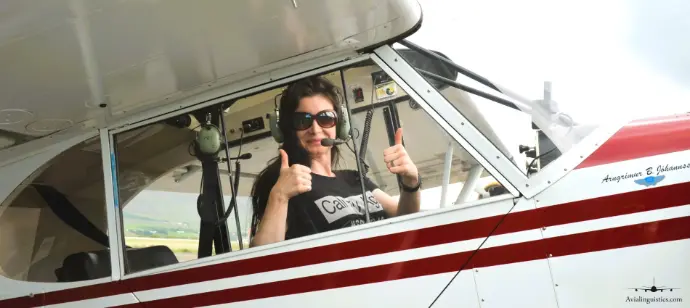
Avialinguistics (2017) is the study of aviation language that intersects two parent disciplines – linguistics and aviation. Interdisciplinary in nature, it requires knowledge in a variety of fields, including applied linguistics and aviation technology.
In merging two autonomous disciplines of completely different scientific interests – linguistics and aviation, avialinguistics opens a new research perspective as well as possibilities of mutual recognition of needs and mutual cooperation and an exchange of research results.
OBJECT
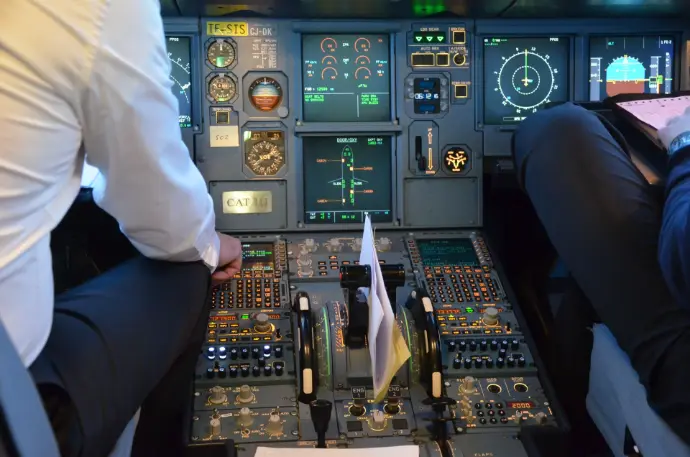
Aviation language is a special language for aviation purposes that is realised in the different forms of the sublanguages or tools, constituting its subsets based on particular aviation domains. Those subsets may share common lexicon and grammar structures, but are treated as separate sublanguages or tools of aviation language with their own characteristic features.
AL = {x1, x2, x3, …, x12}
where we can list the following subsets: aeronautical language (incl. standard phraseology and plain aeronautical language), aviation engineering language (Simplified Aviation Language, aircraft/airport maintenance), aviation law language, air traffic control (ATC) language (incl. aeronautical language, ATC management language, ATC technology language), airport service language (ground handling language, rescue service language), terminal passenger service language, cabin crew language, aviation commerce language, aviation medicine language, aviation jargon.
AVIATION ENGLISH differs from general English
AE ⊄ GE
due to the fact that it relies heavily on a standardized set of short, set phrases and specific terminology, designed to convey complex instructions and information quickly and unambiguously, has a limited inventory of words and simplified grammar and avoids everyday language forms such as questions.
The dependence concerning aviation communication (AC), aviation specialists (AS) and professional message (PM) they produce can be illustrated as follows:
AC = f (AS, PM)
PURPOSE
OF AVIALINGUISTICS
The study of aviation language in all
its professional aspects in relation to practical problems such as the
prescription and the use of aviation language, the study of aviation discourse/communication,
aviation texts, aviation language training methods, testing and rating.

AREAS
OF RESEARCH
- prescriptive view of aviation languages/English
- aviation language description
- aviation language analysis (language use problems: dialects, registers, discourse communities)
- aviation language awareness (contact problems, cultural interactions)
- aviation language competence
- aviation linguistic behaviour
- aviation communication (narrowed down to linguistic aspects)
- aviation discourse
- aviation language error analysis
- improving aviation communication (with reference to linguistic aspects)
- aviation language teaching (resources, training, practice, interaction, understanding, use, contexts, inequalities, motivations, outcomes)
- aviation language learning (skills, awareness, rules, use, context, fluency, automaticity, attitudes, expertise)
- aviation language trainer training
- aviation language assessment and testing (validity, reliability, usability, responsibility, fairness)
- aviation lexicography
- aviation translation

DETAILED
TASKS
- Observation of Aviation English discourse and all its segments, e.g. syntax, phonology, lexis;
- In-depth analysis and description of aeronautical discourse;
- Analysis of Aviation English users' intercultural linguistic awareness;
- Analysis and description of Aviation English communication errors committed by its users (incl. native speakers of English);
- Investigating into successful and non-successful communication strategies in the given context;
- Analysis of applied methods for specialised language teaching against current aviation communication problems, incl. the selection of proper technologies employed in the learning process and teaching materials;
- Analysis of Aviation English testing and rating methods taking into account frequent aviation incidents;
- Preparation of Aviation English tests;
- Designing Aviation English training syllabi;
- Training Aviation English trainers and examiners
BOOKS
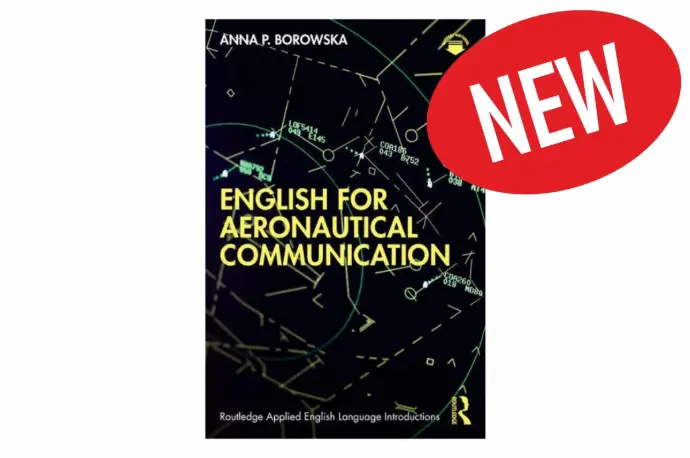
Borowska, A. P. (2025) English for Aeronautical Communication, London: Routledge UK Limited Taylor and Francis Group.
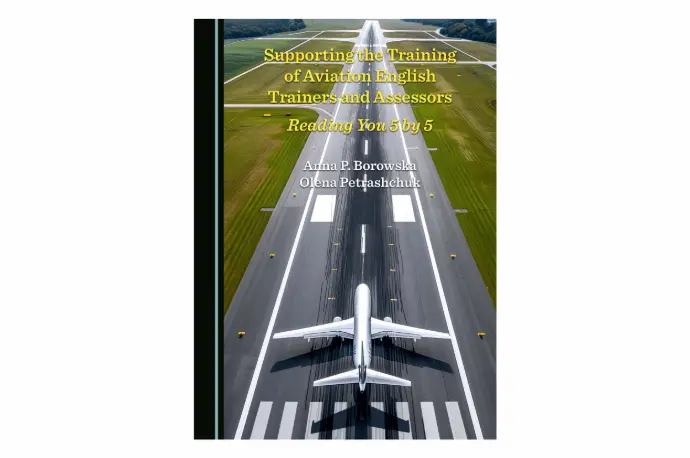
Borowska, A. & Petrashchuk, O. (2024) Supporting the Training of Aviation English Trainers and Assesors: Reading You 5 by 5, pp. 272, Newcastle, UK: Cambridge Scholars Publishing.
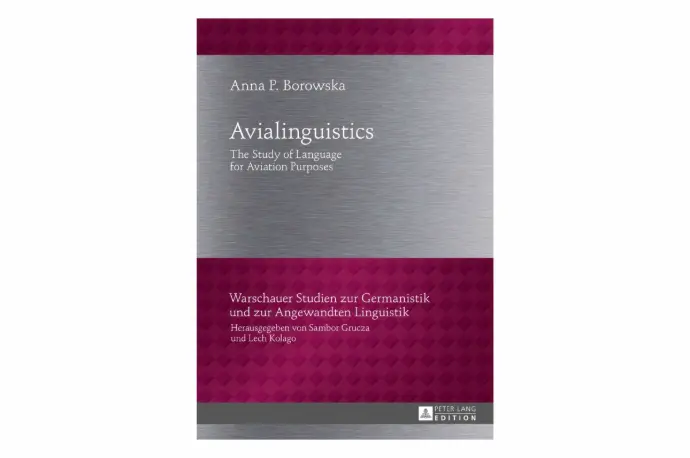
Borowska A. P. (2017) Avialinguistics. The Study of Language for Aviation Purposes. Peter Lang Verlag, Frankfurt am Main, Bern, Bruxelles, New York, Oxford, Warszawa, Wien: pp. 332, ISBN 978-36-3172-140-7.
RESEARCH by Prof. Dr. Hab. Anna P. BOROWSKA
DECODING AERONAUTICAL COMMUNICATION
Borowska, A. (2021) Transmission of Distress and Urgency Calls – Aeronautical English in Use (in:) The 9th European Conference on Language Learning ECLL 2021: Official Conference Proceedings. London: The International Academic Forum (IAFOR), pp. 1—11. ISSN: 2188-112X. LINK
Borowska, A. (2018) How to Interpret Aviation Lingua Franca (in:) Across Borders. Cultures in Dialogue, Prace naukowo-dydaktyczne Państwowej Wyższej Szkoły Zawodowej w Krośnie, Zeszyt 74, Krosno, pp. 57—71. LINK
Borowska, A.
(2017) Decoding negation in aeronautical discourse, Kwartalnik Neofilologiczny, Nr 3/2017, Warszawa, ISSN 0023-5911,
ERIH List (NAT), pp. 366–379. LINK
INTERCULTURAL ASPECTS OF
AERONAUTICAL COMMUNICATION and NATIVE SPEAKERS OF ENGLISH
Borowska, A. P. (2025) Towards Enhanced Efficiency of Radiotelephony Communication – the Case of Native English Speakers, 2025 Integrated Communications, Navigation and Surveillance Conference (ICNS25), Eurocontrol, Brussels, 1-6. Institute of Electrical and Electronics Engineers (IEEE). DOI:10.1109/ICNS65417.2025.10976906. LINK
Borowska, A. P. (2020) Culture Indicators in Global Aeronautical Communication. The ESPecialist: Special Edition – Aviation English, 41(3). 1-17. LINK
Borowska, A. (2018) A Multilingual Speaker in Global Aviation Communication, Applied Linguistics Papers, Vol. 25/2 2018, pp. 11—19. LINK
Borowska, A. (2017) Aeronautical English: an Analysis of Selected Communication Strategies Used by Native English Speakers, Proceedings of the National Aviation University, Kijów, pp.139–146, ISSN 2306-1472, Indeks Copernicus. LINK
Borowska, A. (2017) Is there any dominant culture in global aeronautical settings? (in:) Збірник матеріалів ІІІ-ї Міжнародної науково-практичної конференції, МІНІСТЕРСТВО ОСВІТИ І НАУКИ УКРАЇНИ ДЕРЖАВНИЙ ВИЩИЙ НАВЧАЛЬНИЙ ЗАКЛАД «КИЇВСЬКИЙ НАЦІОНАЛЬНИЙ ЕКОНОМІЧНИЙ УНІВЕРСИТЕТ імені ВАДИМА ГЕТЬМАНА», Kijów, pp. 137–144, ISBN 978-966-956-090-1 LINK
Borowska, A. (2016) Do expert speakers need to practice a language? (in:) A. Borowska/ A. Enright (eds), Changing Perspectives on Aviation English Training, Studia Naukowe – 29, Warszawa: Wydawnictwo Naukowe Instytutu Komunikacji Specjalistycznej i Interkulturowej, Uniwersytet Warszawski, 61–72. LINK
Borowska, A. (2013) Shaping
Cross-Cultural Awareness in Aviation English Communication (in:) Cross-cultural Awareness and Aviation
English Training. The paper presented at the ICAEA 15th Forum, Paris,
France (18th-19th April, 2013) (www.icaea.pata.pl/?opis=paris_2013_report.htm),
1–9. LINK
AVIATION ENGLISH TRAINING
Borowska, A. & Simon, T. (2023) Collaborative Development: How Linguists and Aviation SMEs can Best Serve the Aviation Language Community, Aviation English Special Volume: Enhancing Efficiency in Aeronautical Communications/9th GEIA Proceedings, Applied Linguistics Papers, 27/2: 2023, 55-62. LINK
Borowska A. & Enright, A. (eds) (2016) Changing Perspectives on Aviation English Training, Studia Naukowe – Vol. 29, Warszawa: Wydawnictwo Naukowe Instytutu Komunikacji Specjalistycznej i Interkulturowej, Uniwersytet Warszawski, pp. 111, ISBN 978-83-64020-33-9. LINK
AERONAUTICAL ENGLISH TESTING
Borowska, A. & Petrashchuk, O. (2023) Best Practices for Test Construction based on Test of English for Aviation Personnel (TEAP) (in:) Aviation English Special Volume: Enhancing Efficiency in Aeronautical Communications / 9th GEIA Proceedings, Applied Linguistics Papers Papers 27/2: 2023, 63-78. LINK
- Borowska, A. & Petrashchuk, O. (2019) Comparison of Selected Aeronautical English Tests, Language and Literary Studies of Warsaw, Vol. 9, 217—238. LINK
MILITARY AVIATION DISCOURSE
- Borowska, A. P. (2024) An Avialinguistic Perspective on Communicative Practices in Military Aviation Discourse on Coding Verbal Messages. Global Aviation English Research, E. Friginal, M. Prado, J. Roberts (eds), pp. 37-56. London: Bloomsbury.
- DOI: 10.5040/9781350411708.ch-3. LINK
MAINTENANCE DISCOURSE
- Borowska, A. (2021) Terms in an Aircraft Mechanic’s Professional Life, Academic Journal of Modern Philology. Special Issue, Vol. 13 (2021), PAN, Uniwersytet Wrocławski, pp. 51–59. LINK
In POLISH
- Borowska, A. (2023) Lingwistyka stosowana w lotnictwie. Awialingwistyczne obszary badawcze (in:) Warszawska Szkoła Lingwistyki Stosowanej 50 lat - Dobry Początek, Warszawa: WLS UW. LINK
Borowska, A. (2020) Systematyzacja zasadniczych pojęć i koncepcji w badaniach lingwistycznych w zakresie języka lotnictwa (in:) M. Grygiel/M. Rzepecka (ed.) Komunikacja specjalistyczna w edukacji, translatoryce i językoznawstwie, Vol. 4, pp. 9—21, Rzeszów: Wydawnictwo Uniwersytetu Rzeszowskiego. ISBN 978-83-7996-821-3. LINK
Borowska, A. (2017) Nauczanie angielskiej frazeologii lotniczej, Acta Universitatis Lodziensis. Kształcenie Polonistyczne Cudzoziemców, Vol. 24/2017, 191–203, Łódź: Wydawnictwo Uniwersytetu Łódzkiego, ISSN: 0860-6587. LINK
Borowska, A. (2017) Dyferencjacja zadań badawczych awialingwistyki na tle bieżących potrzeb lotnictwa, Lingwistyka Stosowana – Applied Linguistics – Angewandte Linguistik. Przegląd/Review, Nr 23, 3/2017, pp. 1–14. LINK
Borowska, A. P. (2012) Usprawnienie komunikacji pilot–wieża: zadanie dla lingwistyki języków specjalistycznych, Lingwistyka Stosowana – Applied Linguistics – Angewandte Linguistik. Przegląd/Review, Vol. 5/2012, pp. 19–29, ISSN 2080-4814. LINK
Borowska, A. (2011) O konieczności usprawnienia procesu akwizycji lotniczego języka angielskiego na tle antropocentrycznej teorii języka (in:) Czesław Dyrcz (ed.) Zeszyty Naukowe Akademii Marynarki Wojennej w Gdyni: Publikacje z zakresu bezpieczeństwa w portach lotniczych i morskich, Nr 186A, Gdynia: AMW, pp. 7–12, ISSN 0860-889X. LINK