by Professor Dr. Hab. Anna P. Borowska
Aviation English Expert
Researcher | Instructor | Examiner | Consultant
University of Warsaw - Poland
Faculty of Applied Linguistics
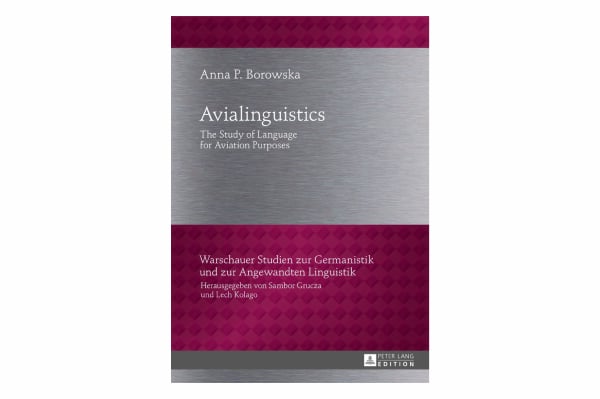
Avialinguistics (2017) is the study of aviation language that intersects two parent disciplines – linguistics and aviation. Interdisciplinary in nature, it requires knowledge in a variety of fields, including applied linguistics and aviation technology.
In merging two autonomous disciplines of completely different scientific interests – linguistics and aviation, avialinguistics opens a new research perspective as well as possibilities of mutual recognition of needs and mutual cooperation and an exchange of research results.

Aviation language is a special language for aviation purposes that is realised in the different forms of the sublanguages or tools, constituting its subsets based on particular aviation domains. Those subsets may share common lexicon and grammar structures, but are treated as separate sublanguages or tools of aviation language with their own characteristic features.
AL = {x1, x2, x3, …, x12}
where we can list the following subsets: aeronautical language (incl. standard phraseology and plain aeronautical language), aviation engineering language (Simplified Aviation Language, aircraft/airport maintenance), aviation law language, air traffic control (ATC) language (incl. aeronautical language, ATC management language, ATC technology language), airport service language (ground handling language, rescue service language), terminal passenger service language, cabin crew language, aviation commerce language, aviation medicine language, aviation jargon.
AVIATION ENGLISH differs from general English
AE ⊄ GE
due to the fact that it relies heavily on a standardized set of short, set phrases and specific terminology, designed to convey complex instructions and information quickly and unambiguously, has a limited inventory of words and simplified grammar and avoids everyday language forms such as questions.
The dependence concerning aviation communication (AC), aviation specialists (AS) and professional message (PM) they produce can be illustrated as follows:
AC = f (AS, PM)
The study of aviation language in all its professional aspects in relation to practical problems such as the prescription and the use of aviation language, the study of aviation discourse/communication, aviation texts, aviation language training methods, testing and rating.
• prescriptive view of aviation languages/English
• aviation language description
• aviation language analysis (language use problems: dialects, registers, discourse communities)
• aviation language awareness (contact problems, cultural interactions)
• aviation language competence
• aviation linguistic behaviour
• aviation communication (narrowed down to linguistic aspects)
• aviation discourse
• aviation language error analysis
• improving aviation communication (with reference to linguistic aspects)
• aviation language teaching (resources, training, practice, interaction, understanding, use, contexts, inequalities, motivations, outcomes)
• aviation language learning (skills, awareness, rules, use, context, fluency, automaticity, attitudes, expertise)
• aviation language trainer training
• aviation language assessment and testing (validity, reliability, usability, responsibility, fairness)
• aviation lexicography
• aviation translation
• Observation of Aviation English discourse and all its segments, e.g. syntax, phonology, lexis;
• In-depth analysis and description of aeronautical discourse;
• Analysis of Aviation English users' intercultural linguistic awareness;
• Analysis and description of Aviation English communication errors committed by its users (incl. native speakers of English);
• Investigating into successful and non-successful communication strategies in the given context;
• Analysis of applied methods for specialised language teaching against current aviation communication problems, incl. the selection of proper technologies employed in the learning process and teaching materials;
• Analysis of Aviation English testing and rating methods taking into account frequent aviation incidents;
• Preparation of Aviation English tests;
• Designing Aviation English training syllabi;
• Training Aviation English trainers and examiners
For flight schools, ATOs, airlines, and aviation training organisations:
I design and develop Aviation English curricula, learning methods, and educational programmes that reflect your operational needs, student profiles, and regulatory context (ICAO language proficiency requirements).
Best AI Website Maker